AI chatbots and “invisible” assistants, among others, are being used during credentialing exams, tests for employee compliance training, pre-hire assessments and technical interviews, and even standard virtual interviews.
There are serious consequences when that happens, and all of them will cost your organization time, trust, reputation, and money—especially those that don’t take action when it happens or even try to stop it.
- Certification bodies lose participants because they see little value in the credentials. Why earn (and pay) for a worthless credential?
- Employees share answers to questions on compliance training exams, and now, regulators are at your door.
- Companies waste resources recruiting and hiring people who aren’t qualified.
- Proprietary exam content and training materials make their way onto the internet because they weren’t protected.
The problem is clear, but what can these AI tools actually do? The next section covers which tools to worry about, shows how they work and which exam formats are at risk, and explains how to detect and prevent unauthorized AI use.
The risks of AI in professional education
AI chatbots and “invisible” assistants, among other tools, are being used during credentialing exams, tests for employee compliance training, pre-hire assessments, and even standard job interviews.
When people are using AI, there are very few exams they can’t pass. Older versions of ChatGPT have already passed the CPA exam, and it even passed licensure tests to practice as an attorney and even a doctor in the United States.
Those exams, aside from a few areas of the CPA exam, primarily use traditional question formats like multiple-choice or true or false. But what about more “hands-on” tasks, like writing code in Java or scripts in Python for a pre-hire assessment? Chatbots and other AI that use Large Language Models (LLMs), such as AI assistants, can also handle these tasks. The code isn’t always perfect, but in all fairness, what code really is? That’s why QA jobs exist.
The problem is that these tools can do enough to help someone who isn’t qualified get the job. And regardless of the exam type or topic, very few are out of AI’s reach.
What AI is being used and how does it work?
The main AI tools to worry about right now are AI chatbots, “invisible” AI assistants, and in-browser features.
AI chatbots
While generative AI chatbots like ChatGPT, Gemini, and Claude can do many different things, their purpose is just to chat with you. That could be a chatting about through a complex problem, or it may be helping with a recipe. AI chatbots generate new, custom responses based on everything they’ve been trained on (basically the entire internet).
Although it seems like they’re copying from those resources, they’re really just predicting what to say next based on the patterns. That’s why people can ask the same exact question and get slightly different responses.
Which chatbot is best?
It depends on the task. Some are better at writing while others excel in math or coding.
ChatGPT can help with almost any task because it’s highly intelligent, well-versed (trained) in most topics, and flexible enough to handle technical and creative tasks.
It can write creative content, develop technical content (e.g., employee training materials, policies, exam rules, etc.), generate working code (or code that’s purposely broken for pre-hire skills assessments), and even create accessible versions of text.
Claude is a strong writer for any type of content. It can write in different styles and can be used to break down technical documents into digestible training modules, make technical edits to any text, and review compliance policies and documentation from an ethical perspective.
Sometimes it needs a bit more direction and context than ChatGPT, but most prefer Claude for writing.
Pi is an emotionally intelligent AI chatbot that’s perfect for venting, asking for advice, preparing for tough conversations, and setting goals.
It won’t be your go-to for coding or math, but it’s great to help process whatever else is happening at work or in your life.
Ask DeepSeek for help when you need to solve math problems or have really technical tasks, especially when you’re writing or debugging code. But, it may struggle with more creative writing tasks.
Gemini is a flexible chatbot that can help with technical writing (including code), creating images, and solving math problems.
Its creative writing isn’t on the same level as ChatGPT and Claude (yet), but it has steadily improved, AND it cites sources pretty often.
Gemini is good at citing sources, but Perplexity is the undisputed champ (because it’s a conversational AI search and answer engine, not a chatbot).
It scours the internet to find answers to your questions, then summarizes everything in a clear and concise way that’s easy to digest, and provides links to find out more.
NotebookLM is a research assistant that turns the files and sources you give it (e.g., PDFs, Docs, websites, text, etc.) into useful resources for training and certification. Use it to produce policy briefs, SOP checklists, training outlines, and FAQs. It also suggests relevant questions from your content and saves responses to your notebook, or you can ask your own and get cited answers.
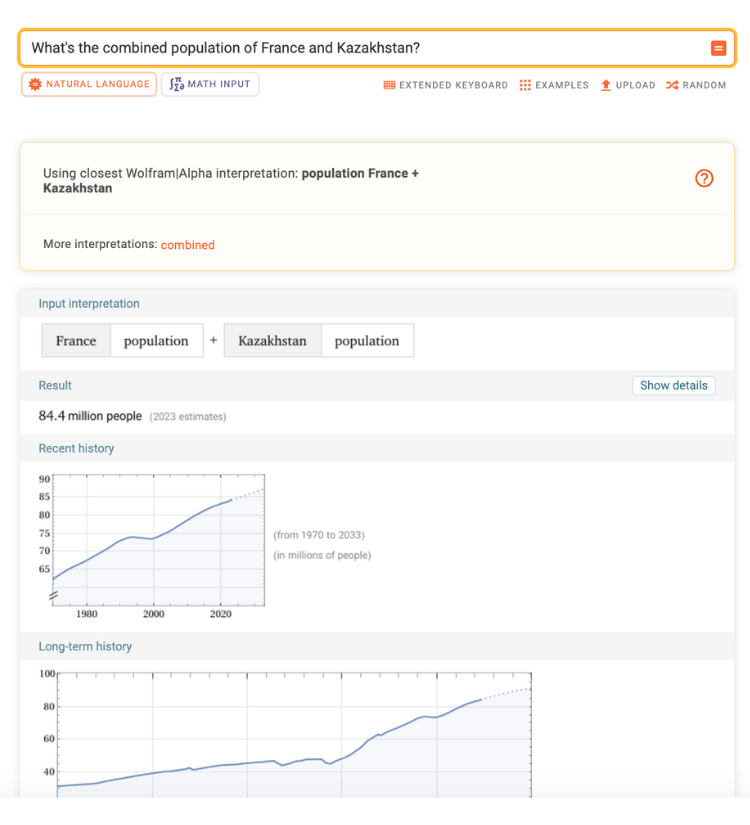
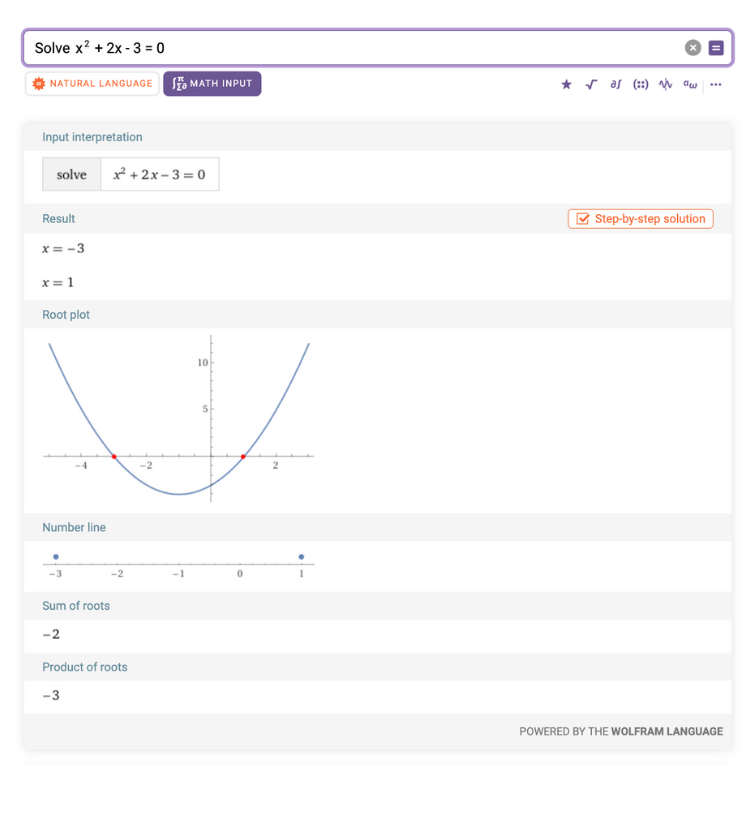
Wolfram Alpha isn’t a chatbot, but it’s still relevant to mention here because it has some similar features and it’s extremely useful for anything math or science-related.
It’s a computational knowledge engine, which is a form of AI. Put simply, it understands what you ask (like a chatbot does), and it answers your question using algorithms and its internal knowledge base. However, it doesn’t chat with you or provide links; it only provides computed answers.
Invisible AI assistants
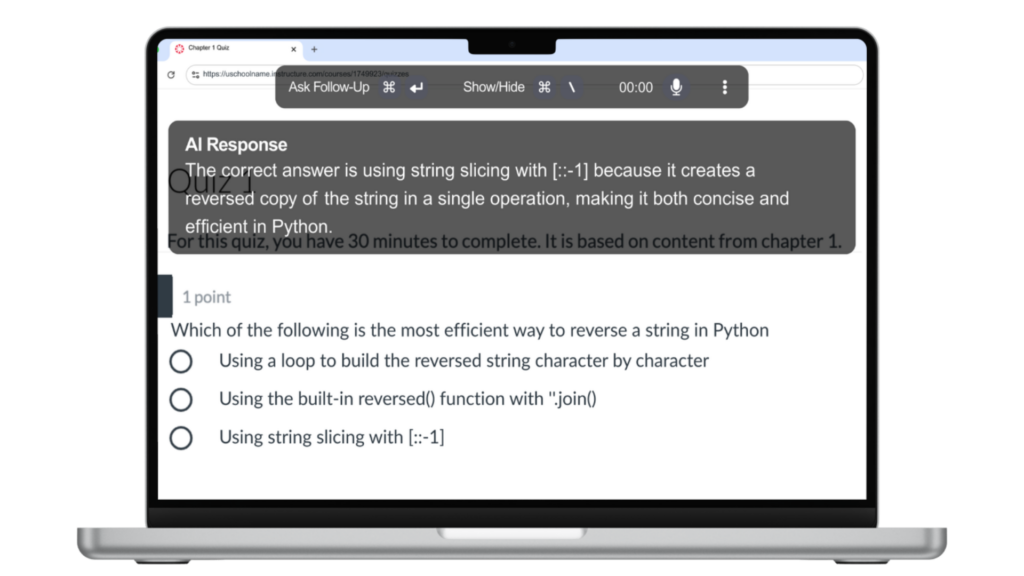
Think of invisible AI assistants as chatbot teleprompters. They can see what’s on the screen (e.g., exam questions or coding tasks), hear what’s being asked, and provide answers in real-time.
These tools use LLMs (the brains of a chatbot) like ChatGPT and Claude to answer questions to:
- Display word-for-word responses to interview questions quickly enough for candidates to read aloud
- Answer exam questions in formats like multiple-choice and true/false
- Generate code to use within a development environment
- Give step-by-step instructions to complete technical tasks
- Write long or short-form responses
What makes invisible AI assistants so difficult to detect?
- Transparent overlays: AI answers appear in see-through windows over the interview app, invisible during screen share.
- Operates in the background: Runs as a hidden process with no visible window, excluded from taskbars, app lists, and screen recordings.
- Works on cell phones: Candidates run the AI assistant on their phone or tablet, which can be out of view of their main device’s webcam.
- Keyboard shortcuts: Let users toggle or move overlays (e.g., Ctrl/⌘ + B), or open hidden browser tabs undetected.
In-browser help features (browser panels)
Google’s homework help tool can be a useful resource for learning, but it can also be used to get immediate answers to exam questions.
Users just highlight a test question or on-screen text they need help with and receive answers, explanations, videos, and other resources in a browser side panel.
Please rotate your device to view the interactive walkthrough
How to prevent the use of AI
Browser lockdown software isn’t enough to prevent the use of AI tools because test takers can still use other devices. Tests need to be remotely proctored to effectively prevent test takers from using AI. Here’s how it works:
Block all applications or just allow the ones you want
The proctoring software should allow exam admins to block all applications, such as AI coding/interview assistants, screen recording apps, web conferencing apps, or remote access software.
Exam administrators can also choose to allow specific applications, such as Excel or Word, during a technical interview that requires completion of accounting-related tasks. This way, candidates only have access to the apps/software needed for the exam and nothing else.
Detect cell phones and other devices
Most AI tools can be used on secondary devices, so you need a proctoring solution that can detect and block test takers from using them. But you can’t just hope that a proctor will see one. You need proctoring software that can detect cell phones and other devices, uses AI to identify Apple devices nearby, and flagging when candidates try to search test questions on a secondary device.
Monitor from all angles
You can monitor and record candidates during technical interviews and exams using their main device’s webcam and you can use second camera monitoring for a wider, multi-angle view of their environment.
Scan their workspace & verify ID
Before exams or interviews start, admins can require test takers to complete a workplace scan to make sure that they don’t have access to unauthorized resources like cell phones, notes, and even other people.
Detect speech that matters
Honorlock’s AI listens for test takers to say phrases that activate AI assistants like Siri and Alexa while ignoring unimportant noises, like coughing or a dog barking.
Integrating Honorlock with Docebo
Honorlock’s online proctoring software integrates directly with Docebo, which keeps testing in one secure, familiar environment. Exam administrators build exams in Docebo just like they already do, and test takers complete their exams in Docebo.
The benefits of this direct integration:
- Takes less than an hour to complete the integration
- No extra logins or passwords
- Timestamped reports and recordings are available in Docebo
- More security because data is shared only between Honorlock and the Docebo client
The true cost of leaked exam content
Leaked exam content has always been an issue, but the problem is amplified with AI, which makes it much easier and quicker to access your content.
When your content is leaked online, there’s a pretty solid chance of it being used to train the AI. If that happens, the AI tools can potentially use your content, maybe even word-for-word. Another problem is that most chatbots can access the internet, which means your leaked content can be used in their responses within an hour or so.
Leaked content's industry-wide impact
Regardless of whether AI gets ahold of your content or not, if it gets leaked online, it means the test taker had the opportunity and ability to copy it directly from your exam or take a screenshot or photo.
What would happen to your credentialing program if candidates and the companies that hire people who earn those credentials knew all the answers to the exams could easily be found or bought online? Why would candidates waste time and money on credentials that aren’t taken seriously? And why would companies hire them?
What industries struggle with leaked exam content?
Answer sharing (and selling) is a legitimate issue for basically any industry that delivers assessments, including healthcare, cybersecurity, teaching, plumbing, and even law enforcement. Each has experienced situations where test content was shared, and in some cases, sold online as “exam prep materials.”
As you can imagine, this cost the organizations involved a lot of money, whether directly from fines and resources spent on redeveloping their exams, or somewhat indirectly from damaged trust and reputation.
Nursing and Medical
Nursing certification exams
The Pediatric Nursing Certification Board (PNCB) realized its Acute Care CPNP-AC exam content had been shared online and had to suspend testing while developing an entirely new certification exam.
Medical licensing exams
Many of the American Board of Internal Medicine (ABIM)’s copyrighted questions were posted verbatim on an exam prep company’s website after 139 physicians shared them with the director of that company. And in another case, hundreds of U.S. medical licensing exam scores were voided after candidates memorized and shared questions. Unfortunately, candidates who didn’t participate in sharing the content were also forced to retake the exam after investigators found identical answers and suspicious timing patterns.
Accounting and finance
The Big Four and their affiliates have paid out more than $132.5 million in fines since 2022, including one single instance with a $100 million fine. Employees at all levels, including senior leadership, were caught sharing answers to internal employee training exams, which are required to meet compliance standards. Along with the fines, the firms were ordered to update ethics policies and add stricter monitoring of employee testing.
Accounting and finance
Even though civil service exams aren’t credentialing exams, answer sharing has the same consequences.
- Cadets at the Pennsylvania State Police Academy received answers to exam questions and shared them with each other for the traffic law, criminal law, and final cadet exams.
- The in-person 2022 NYPD Sergeant promotion exam was heavily compromised when officers used their phones to take pictures of test questions and share answers with other officers. Ultimately, 35% of exam questions were shared with over 1,200 officers.
Cybersecurity
Employees from NCC Group, a CREST member company, created and shared proprietary cybersecurity certification exam questions and answers. CREST, which accredits cybersecurity firms and certifies professionals, said NCC Group staff compiled the test materials and uploaded them to GitHub and Dropbox, which violates NDAs and CREST’s code of conduct.
Plumbing
A two-part plumbing certification exam and its answers were leaked and shared days before 224 apprentices sat for it. The agency overseeing the exams was forced to create new question banks and update program materials.
Teaching
A test-prep company had staff repeatedly take the Florida Teacher Certification Exams (FTCE) and the Florida Educational Leadership Exam (FELE) in order to memorize the questions to republish and sell online. The stolen exam content, which was owned by the Florida Department of Education and the State Board of Education, was republished in study guides and training materials and sold to customers.
Proctoring software to secure proprietary exam content
Proctoring software to find and remove leaked content, prevent test takers from using their phones and other devices, and block them from recording their screens, taking screenshots, and copying and pasting your content.
- Search & DestroyTM: Automatically scans the internet for your proprietary exam content within minutes. If it finds any, you can send takedown requests with a single click.
- Video monitoring: Uses the webcam and an optional second camera to monitor for unauthorized resources like phones, which could be used to take photos of exam content, or pen and paper, which could be used to write down questions.
- Cell phone detection: Detects when test takers try to use cell phones and other devices (e.g., tablets and smartwatches) to look up questions and identifies nearby devices using AI-enabled Apple Handoff technology.
- Locked browser: Records the candidate’s screen while blocking unauthorized websites, applications, and screen recorders. It also prevents them from taking screenshots and copying and pasting your content.
Securing exams across industries while improving the experience Honorlock
Docebo University
Scaling certification proctoring & cutting costs with Honorlock
Docebo University (DU) needed to protect the integrity of its certification programs, but faced challenges with its previous proctoring provider. The solution, which required a 16-week setup, was unreliable and forced DU’s team to spend 20 hours per week manually proctoring exams, which created a poor user experience.
Docebo chose Honorlock for its reliable, scalable solution that integrated directly into their platform with a same-day, plug-and-play setup. Since implementing Honorlock, DU has:
- Scaled to over 45,000 learners
- Eliminated the 20 hours of manual proctoring
- Saved over $50,000 annually
Healthcare Services Group (HCSG)
Improving accessibility & security while eliminating rescheduling fees
HCSG struggled with certifying food service staff in part because of the previous proctoring solution. It lacked accessibility, created language barriers, and the solution provider charged HCSG $14,000 in rescheduling fees.
HCSG decided to launch its own certification body and partnered with Honorlock for its accessibility, multilingual support, and on-demand testing that eliminated rescheduling fees. They’ve dramatically improved the certification experience and expanded career opportunities while still securing exam integrity.
Trust20
Improving security and removing obstacles for test takers
Trust20, a provider of online food safety certifications, faced significant challenges with previous proctoring solutions. Spanish speakers were at a disadvantage because pre-test instructions and proctor chats were not translated into Spanish, even though the exam was. They also needed stronger security, fewer technical hiccups, and faster support.
Trust20 chose Honorlock because it met ANAB requirements with strong exam security and because it drastically improves the exam experience for candidates. They don’t have to deal with scheduling or rescheduling hassles, live support responds in seconds, and they don’t need to download bulky software.
Honorlock’s Analytics Hub also provides managers with clear reporting in a straightforward interface, and they can review timestamped video recordings of any flagged behavior.
Academy of Lactation Policy and Practice (ALPP)
Improving security and removing obstacles for test takers
ALPP needed to renew its ANAB accreditation for its lactation counselor certification, which required it to prove its certification exams met the strict ISO/IEC 17024 standard for test validity and integrity.
ALPP partnered with Honorlock to provide specific services and features, such as “Pro Mode,” that were necessary to satisfy the requirements. This collaboration helped ALPP to renew its accreditation while creating a better testing experience with more access and flexibility for participants.