
ChatGPT has had educators nervous since it 2022. It wasn’t the first generative AI chatbot, but it was the one that got everyone’s attention. Since then, similar chatbots have popped up, like Gemini, Claude, and Grok, along with many different chatbot-like tools such as Perplexity, Wolrfram Alpha, and NotebookLM.
And people use chatbots for just about everything now. They can write everything from long-form essays to punny jokes, solve math problems, and to summarize and simplify text.
The issue is that ChatGPT and other chatbots have been used to cheat on exams (which is why you’re here). ChatGPT is highly capable and there are very few exams it can’t help with.
Virtual interviews aren’t even safe anymore because of AI exam helpers, which are basically just an on-screen chatbot that operates within a transparent box. And technical interviews are definitely at risk because chatbots can write code and provide step-by-step instructions of how to complete tasks within real platforms.
See how Invisible Ai assistants work
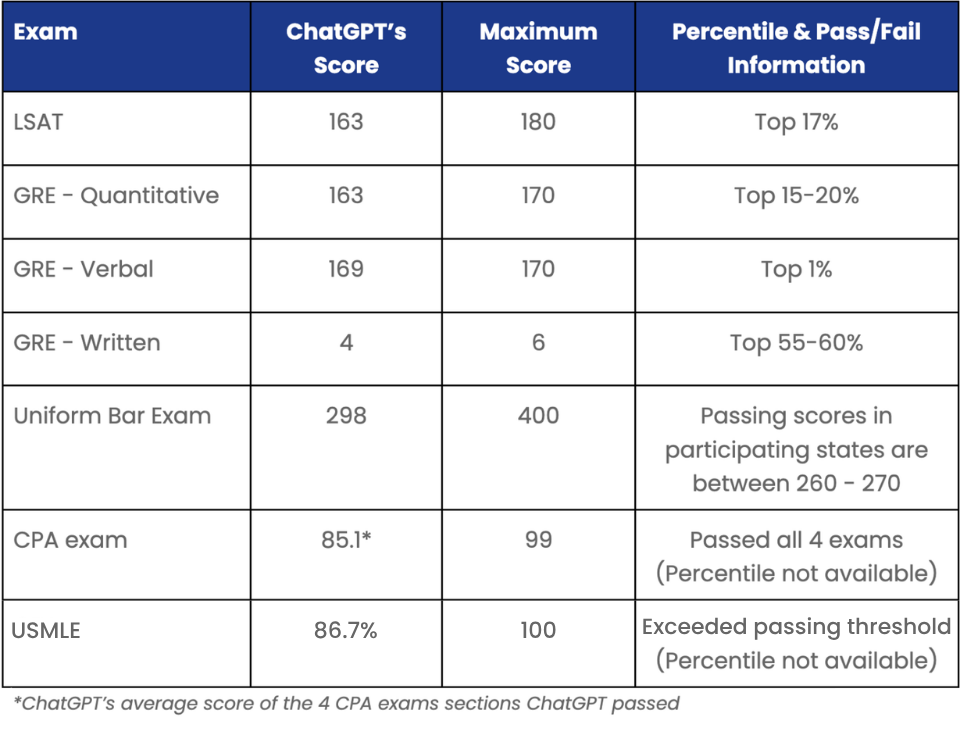
Early-ish versions of ChatGPT passed these exams
Can ChatGPT be detected as plagiarism?
Plagiarism tools can’t reliably detect ChatGPT because they look for text that’s copied exactly from the source or looks pretty similar to it. That’s a big problem because ChatGPT doesn’t just copy from the resources it was trained on, like websites, research studies, news, code, etc.
It’s similar to how you learn from all kinds of different sources. But if someone asks you a question about it, you don’t just recite answers word for word. You put it into your own words, make connections, and you can explain it differently depending on who you’re talking to. It isn’t an perfect analogy, but that’s the gist of how ChatGPT works and why plagiarism detection doesn’t.
Can AI detectors detect ChatGPT?
If a test taker copies text directly from ChatGPT without making any edits, AI detectors are usually accurate. But realistically, test takers will probably make a few changes before submitting. Once AI-generated text is altered, even if another AI tool is used to make the changes, the accuracy of AI detection decreases (Liu et al., 2024; Weber-Wulff et al., 2023).
How does AI detection work?
AI detection assesses how predictable the writing is (perplexity), how sentence length and structure vary, and whether it sounds a little too “cookie cutter.”
Human writing usually has more variety and specific details, so when text is predictable or the sentences are all a similar length, AI detectors might flag it as AI-generated.
What is an acceptable AI detection score?
That’s the million dollar question, but there’s no real answer. Whether the AI detector indicates that the text is 10%, 30%, or 85% AI-generated, educators have to make that call.

Honorlock’s hybrid proctoring solution prevents the use of ChatGPT using a combination of AI and live proctors. Some of the proctoring features we use to control AI chatbots are covered below.
Several of Honorlock’s remote proctoring features work together to detect cell phones and other secondary devices (laptops, tablets, smartwatches, etc.), so you don’t have to rely on a live proctor to catch it in real time.
With Honorlock’s BrowserGuard, instructors can block access to all external resources like websites, applications (such as ChatGPT), and browsers, or allow access to specific resources like research journals, case studies, and word processors such as Word or Google Docs.
That flexibility lets educators give learners the supplemental materials they need while still stopping unauthorized use of chatbots and other AI writing tools.
Honorlock’s BrowserGuard also records the participants’ desktops and prevents keyboard shortcuts, like copying and pasting. If copy/paste is attempted, the participant receives a notification that it isn’t allowed and the AI marks it as a medium flag.
Locking the browser is just one piece of preventing AI cheating, and on its own it can’t tell you if someone is:
- Using a phone to access ChatGPT or browse the internet
- Asking Siri or Alexa to access apps/sites
- Having someone else write the essay or take the exam
- Typing what a friend is reading to them from off-camera
If your proctoring platform doesn’t have smart voice detection, participants can use voice assistants like Siri or Alexa to open ChatGPT, ask questions, and have the answers read aloud.
Honorlock’s Smart Voice Detection listens for specific keywords or phrases, like “Hey Siri” or “OK Google,” and it records and transcribes audio while the exam is in progress. If it detects potentially dishonest behavior, a live proctor is alerted to review the situation and intervene if necessary.
Honorlock’s proctoring software makes it quick to scan the work space for unauthorized resources like cell phones, calculators, notes, and even other people, and it monitors and records behavior for the whole exam. For even better coverage, a second camera gives you a wider, multi-angle view of the test environment.
This way, you’ll know that test takers aren’t accessing ChatGPT from other devices, using their notes, or asking other people for help.
Instructors can create rules that specify a certain number of hours participants have to complete the written assignment once they begin. Honorlock’s remote proctoring software and services are available 24/7/365, so they can write their essays anytime they’re ready within your set time frame, and you’ll know it’s being proctored.
Honorlock’s Live Pop-In secures online assessments and assignments with a hybrid proctoring approach that uses AI to monitor the test environment and behavior, and a live proctor reviews anything the AI flags to determine if they need to intervene or not.
The proctor only intervenes when there’s a real concern, so test takers aren’t interrupted unnecessarily, which makes for a less intimidating and non-invasive experience.
You need to know that the person taking the proctored exam is the same person getting credit in the class. Honorlock’s ID verification takes about 60 seconds. It captures a picture of the test-taker along with their photo ID.
ChatGPT and many of the AI chatbots are powerful tools that have advantages and disadvantages in online learning. Use Honorlock’s solution to stay ahead of the curve and in control of if, how, and when chatbots and other AI are used in your courses and assessments.