
It’s hard to detect and prevent exam cheating, especially when they’re taken online. Students are resourceful, tech-savvy, and they have plenty of tools that make cheating easier unless instructors use smart assessment design, effective proctoring tools, and have a true understanding of why students cheat beyond obvious reasons like wanting better grades and just because they can get away with it.
Why do college students cheat on exams?
College students often cheat on exams because they feel unprepared, want better grades, or just because they can get away with it. But beyond the obvious reasons, cheating is complex and has a lot of gray areas.
You can learn more of the real reasons students cheat, but here are three interesting reasons:
Do attitudes and emotions impact cheating?
Attitudes, morals, and values impact intentions to cheat, but ultimately, they don’t reduce cheating behavior (Ababneh et al., 2022; Johnson‐Clements et al., 2024; Kasler et al., 2023).
Think of it this way: You know that driving above the speed limit is illegal, so you don’t intend to speed to the airport. But if you’re running late for a flight, you’ll probably put the pedal to the metal even though you know it’s wrong.
Cheating works similarly. Students may believe cheating is wrong, but when they’re stressed, unprepared, have an easy chance to cheat, or believe peers are cheating, they may still decide to do it (Stone et al., 2009; Waltzer & Dahl, 2023).
Students also justify cheating by telling themselves (using excuses) that the class was unfair, the workload was too much, no one was harmed, or other students were doing it too (Lee et al., 2020; Rettinger, 2017). Negative emotions, like anxiety, increase cheating, especially if they expect to perform poorly or aren’t prepared (Eshet et al., 2024; Salgado et al., 2022).
Plagiarism is confusing and ambiguous
Students generally understand obvious plagiarism, but there’s still confusion about what information needs to be cited, how to cite it, and where to draw the line between acceptable source use and plagiarism (Waltzer & Dahl, 2021; Waltzer & Dahl, 2023).
Common knowledge usually doesn’t need to be cited. But what does “common knowledge” even mean?
Yale defines common knowledge as “knowledge that most educated people know or can find out easily in an encyclopedia or dictionary.”
But to play devil’s advocate:
- What counts as “educated”?
- How much does “most” mean?
- When is something common to one audience but not another?
- What does “easily” entail?
- Which encyclopedia or dictionary?
Yale acknowledges that the definition is ambiguous and changes based on the audience, but that ambiguity is exactly why citation rules can confuse students, even when they generally understand plagiarism.
Is it still cheating if students genuinely don’t know how or what to cite?
What if it was an honest mistake because their other classes require APA, but your class requires MLA?
Regardless of whether it’s intentional or an innocent mistake, it needs to be addressed, but with genuine effort to understand the context of what happened.
ebooks to continue learnin'
They believe others students are cheating and faculty don’t care
When students see peers cheat without consequences, academic dishonesty starts to seem normal and easy to get away with. If cheating goes unaddressed, that message becomes harder to ignore because students may assume the behavior will not be noticed or taken seriously (Stephens, 2017; Zhao et al., 2022).
Students’ logic becomes simple: If everyone else is doing it, why shouldn’t I? (Stephens, 2017)
Faculty often avoid addressing and reporting cheating for several reasons (MacLeod & Eaton, 2020; Staats et al., 2009):
- Reporting cheating is time-consuming, and faculty often doubt their institution handles misconduct consistently or effectively.
- Evidence of cheating wasn’t conclusive enough.
- Accusing a student of cheating is stressful for both faculty and students.
- Worries about the situation escalating, such as the student denying the accusation or the risk of legal repercussions.
Assessment strategies and technology to prevent cheating on online exams
Verify that it’s the right person taking the test
Online proctoring systems can help verify identity by capturing a photo of both the test taker and their ID. This way, you’ll know that the person taking the proctored exam is getting credit for the online course.
Prevent students from using AI
AI chatbots and “invisible” desktop assistants give students new ways to cheat during exams and written assignments. Chatbots can write essays and responses, while the invisible desktop assistants can read exam questions and provide answers through a transparent overlay.
The interactive example below shows what an invisible assistant looks like during a traditional online exam and an oral exam.
However, a few proctoring tools can block unauthorized AI during exams and assignments. In addition to those tools, you can implement the strategies below to mitigate the use of AI.
Authentic assessments for students to prove they can apply what they’ve learned to complete projects and tasks in real-world situations.
Example: Instead of asking nursing students to answer a series of multiple-choice questions, an authentic assessment may ask them to record a short video where they identify the parts of a stethoscope and demonstrate how to use it while explaining what they’re doing.
Assignments tied to in-class content, such as creating a short essay comparing peer discussion posts or a personal reflection on the results of an in-class survey.
Example: Select two peer responses from last week’s discussion, each focusing on a different learning theory. Write a 2-page comparison of their similarities and differences, then create a visual (mind map, concept map, or infographic) to show how your own response aligns with or differs from the two you chose.
Breaking larger projects into a series of smaller assignments.
Example: Replace a single, long-form research paper with smaller assignments like brainstorming topics, submitting a proposal and outline, and writing a draft for peer review before writing the final research paper.
Ask students to submit different pieces in different formats, such as a mind map for brainstorming, a concept map for the proposal/outline, and a voice-over presentation for the reflection.
Detect cell phones, smartwatches, and other devices
Cell phones are a huge threat to exam integrity. In fact, it’s the most common way students try to cheat on proctored exams.
There are many types of online proctoring services, and many rely heavily or only on live proctoring. That means they depend on a live proctor, who may be watching 10-12 exams at once, to catch cheating in real time, such as a student using a cell phone.
What are the odds that one proctor will catch every student sneaking to use their cell phone during an exam?
However, some proctoring companies take a different approach that uses AI to detect phones and other devices, with a live proctor reviewing it once it’s flagged.
Help reduce students’ test anxiety
Whether emotions are positive (e.g., enjoyment and pride) or negative (e.g., boredom, frustration, anxiety), they can have a significant impact on learning and performance, and they can influence academic dishonesty.
Exams are naturally stressful for most people, and they can increase anxiety. Anxiety can interfere with attention, recall, problem solving, motivation, and performance (Alshareef et al., 2025; Chu et al., 2026).
And when anxiety increases, students may be more likely to cheat (Eshet et al., 2024; Stone et al., 2014). That doesn’t mean anxious students are cheaters. It means anxiety can make cheating feel like a way (or the only way) to avoid failing (Stone et al., 2014; Waltzer & Dahl, 2023).
Practical tips for faculty to help reduce student test anxiety:
- Clearly explain what the test covers, question types, time limit, grading criteria, etc.
- Show how to use any technologies (include a demonstration if possible.)
- Provide practice exams to test technology and devices.
- Review the rules and answer any questions.
- Share technical support contact information and details on how to access it.
- Explain available accommodations and how to request them.
Address cheating every time it happens
No instructor looks forward to talking with a student about suspected cheating, but avoiding the conversation creates bigger problems for the instructor and the institution. And cheating goes unaddressed more than many instructors may realize.
A survey found that 48% of faculty said they had ignored cheating when the evidence was not entirely conclusive (MacLeod & Eaton, 2020).
And when cheating goes unaddressed, students may assume the rules do not matter, repeat the behavior, and/or tell peers that misconduct has no real consequence. In other words, it creates a culture of cheating.
Conversation prep
Talking to a student about suspected cheating can be uncomfortable, but preparation makes the conversation more productive and fair. Before the meeting, review the evidence, know the relevant policy, and plan how you will explain your concerns.
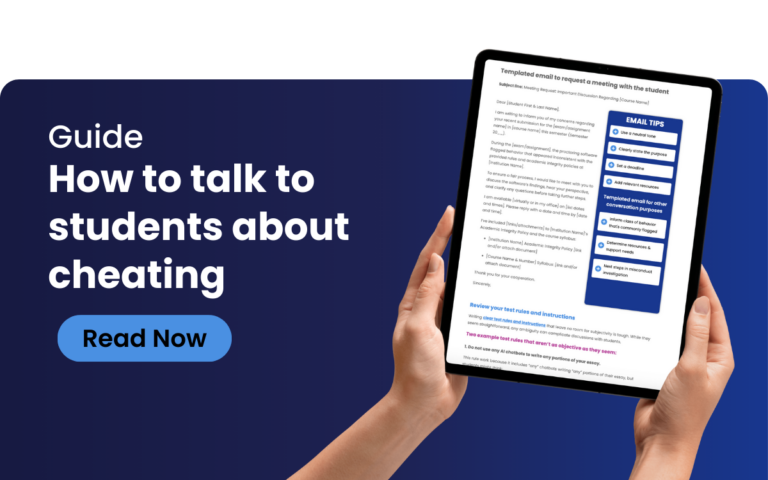
Another thing to consider is whether disabilities could explain what happened. For example, did a neurological condition cause the student to twitch, make repeated movements, or have a tic that was misread as suspicious behavior?
Remember the goal of the conversation
The goal is to have a respectful, objective conversation to determine what happened, whether misconduct occurred, and what the next steps are based on your institution’s policy. Focus on the evidence, give them a chance to respond, and follow the process your institution has in place.Protect test content from being leaked online
Forums like Reddit and Quora, as well as websites like Chegg and Quizlet, which pose as “homework help” sites make it easy and common for your test content to be leaked.
One university found that 56% of their exam content was leaked on Chegg.
The university said: “Alarmingly, we found over half of the audited units had cheating content on Chegg, [which] is broadly used to cheat and 50% of questions asked on Chegg are answered within 1.5 hours. This makes Chegg an appealing tool for academic misconduct in both assignment tasks and online exams.”
Instead of manually searching for individual questions, Search & Destroy™ automatically scans the web for your leaked test content in a few minutes. If it finds any, it shows you where and allows you to send one-click takedown requests. Easy peasy.
Listen for voices and instead of sounds
Use exam proctoring tools that detect voices and phrases that may suggest misconduct instead of unimportant noises. This can include voice assistant prompts like “Hey Siri” or “OK Google,” along with custom phrases related to the exam. When the system detects something that needs attention, a live proctor can review the situation and step in when needed.
This gives instructors another way to protect exams without making every student feel watched the entire time.
Write specific test rules
Students need to know exactly what is and is not permitted. A rule like “Do not talk during the test” may seem pretty clear, but it still leaves room for interpretation.
A stronger version would be: “Do not communicate with anyone during the test through speech, gestures, notes, messages, or any electronic device.”
Providing students with clear, objective exam rules helps reduce confusion, close loopholes, and make it easier to apply the same standard to every student.
Restrict time limits
Unless students require accommodations for additional time, setting strict time limits can help reduce cheating.
Several studies found that students take about twice as long to complete unproctored exams compared to students taking proctored exams. Some of the authors suggested that it may be because they spend more time searching for answers online during unproctored tests (Alessio et al., 2017; Howard, 2020; Zhang, 2024).
Monitor behavior from ALL angles
Use proctoring technology to your advantage to monitor students’ behavior during online exams, such as:
- Video monitoring, which can include a second/side camera, so you can see if they’re trying to look at their notes and use other resources during the test.
- Smart Speech detection (not sound detection) so you can tell if they’re talking to someone else in the room or asking Siri for help, but not have to review flags for unimportant noises like coughing or a doorbell ringing.
- Locking the browser and recording their screen to see if they try to access other websites or attempt to copy and paste questions into a document.
Academic integrity has to be taught, supported, and continually reinforced. Preventing cheating on online exams means improving online assessment design, using proctoring software to detect and prevent misconduct, and preparing students as much as possible.
If you’re missing any of those, are your exams really valid?
References
Ababneh, K. I., Ahmed, K., & Dedousis, E. (2022). Predictors of cheating in online exams among business students during the Covid pandemic: Testing the theory of planned behavior. The International Journal of Management Education, 20(3), 100713. https://doi.org/10.1016/j.ijme.2022.100713
Alessio, H. M., Malay, N., Maurer, K., Bailer, A. J., & Rubin, B. (2017). Examining the Effect of Proctoring on Online Test Scores. Online Learning, 21(1). https://doi.org/10.24059/olj.v21i1.885
Alshareef, N., Giga, S., & Fletcher, I. (2025). Test anxiety, emotional regulation and academic performance among medical students: A qualitative study. Medical Education Online, 30(1). https://doi.org/10.1080/10872981.2025.2505177
Chu, K. L., Edwards, E. J., & Vaughan, R. S. (2026). Untangling the influence of anxiety and motivation on cognitive performance of international university students. Journal of International Students, 16(1), 127–140. https://doi.org/10.32674/kb71w355
Eshet, Y., Grinautsky, K., & Steinberger, P. (2024). To behave or not (un)ethically? The meditative effect of mindfulness on statistics anxiety and academic dishonesty moderated by risk aversion. International Journal for Educational Integrity, 20(1), 6–18. https://doi.org/10.1007/s40979-024-00151-w
Howard, D. (2020). Comparison of exam scores and time taken on exams between proctored oncampus and unproctored online students. Online Learning, 24(4), 204-228. https://doi.org/10.24059/olj.v24i4.2148
Johnson-Clements, T. P., Curtis, G. J., & Clare, J. (2024). Testing a psychological model of post-pandemic academic cheating. Journal of Academic Ethics. https://doi.org/10.1007/s10805-024-09561-4
Kasler, J., Sharabi-Nov, A., Shinwell, E. S., & Hen, M. (2023). Who cheats? Do prosocial values make a difference? International Journal for Educational Integrity, 19(1), 6–16. https://doi.org/10.1007/s40979-023-00128-1
Lee, S. D., Kuncel, N. R., & Gau, J. (2020). Personality, attitude, and demographic correlates of academic dishonesty: A meta-analysis. Psychological Bulletin, 146(11), 1042–1058. https://doi.org/10.1037/bul0000300
MacLeod, P. D., & Eaton, S. E. (2020). The paradox of faculty attitudes toward student violations of academic integrity. Journal of Academic Ethics, 18(4), 347–362. https://doi.org/10.1007/s10805-020-09363-4
Rettinger, D. A. (2017). The role of emotions and attitudes in causing and preventing cheating. Theory Into Practice, 56(2), 103–110. https://www.jstor.org/stable/48546867
Salgado, J. F., Cuadrado, D., & Moscoso, S. (2022). Counterproductive academic behaviors and academic performance: A meta-analysis and a path analysis model. Frontiers in Psychology, 13, 893775–893775. https://doi.org/10.3389/fpsyg.2022.893775
Staats, S., Hupp, J. M., Wallace, H., & Gresley, J. (2009). Heroes don’t cheat: An examination of academic dishonesty and students’ views on why professors don’t report cheating. Ethics & Behavior, 19(3), 171–183. https://doi.org/10.1080/10508420802623716
Stephens, J. M. (2017). How to cheat and not feel guilty: Cognitive dissonance and its amelioration in the domain of academic dishonesty. Theory into Practice, 56(2), 111–120. https://doi.org/10.1080/00405841.2017.1283571
Stone, T. H., Jawahar, I. M., & Kisamore, J. L. (2009). Using the theory of planned behavior and cheating justifications to predict academic misconduct. Career Development International, 14(3), 221–241. https://doi.org/10.1108/13620430910966415
Stone, T. H., Kisamore, J. L., Jawahar, I. M., & Bolin, J. H. (2014). Making our measures match perceptions: Do severity and type matter when assessing academic misconduct offenses? Journal of Academic Ethics, 12(4), 251–270. https://doi.org/10.1007/s10805-014-9216-0
Waltzer, T., & Dahl, A. (2021). Students’ perceptions and evaluations of plagiarism: Effects of text and context. Journal of Moral Education, 50(4), 436–451. https://doi.org/10.1080/03057240.2020.1787961
Waltzer, T., & Dahl, A. (2023). Why do students cheat? Perceptions, evaluations, and motivations. Ethics & Behavior, 33(2), 130–150. https://doi.org/10.1080/10508422.2022.2026775
Zhang, N., Larose, J., & Franklin, M. (2024). Effect of unproctored versus proctored examinations on student performance and long-term retention of knowledge. The Journal of Chiropractic Education. https://doi.org/10.7899/JCE-23-16